
Day 1 : Tournoux Loop
Description
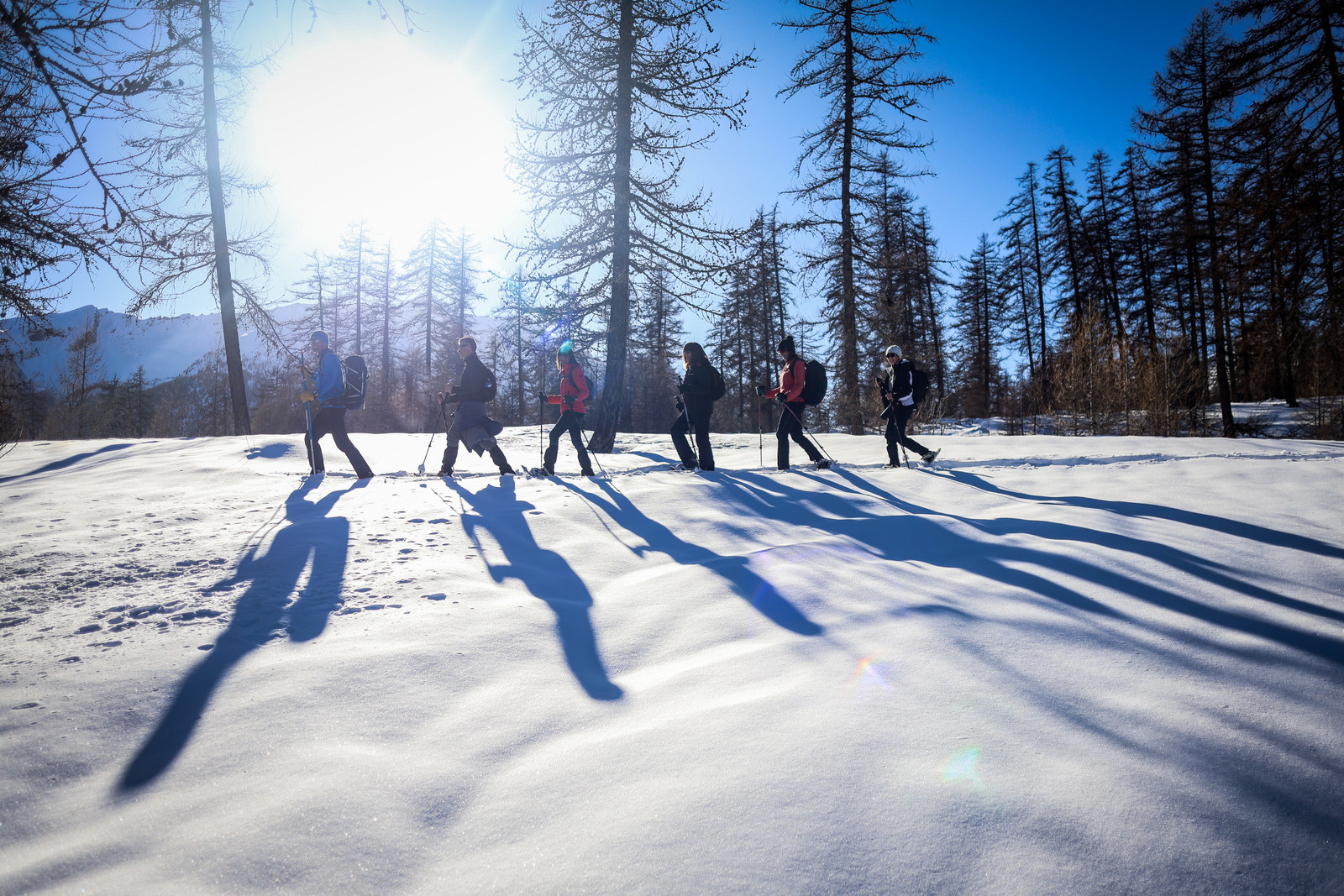
For your first day, head to the Tournoux plateau, where a scenic loop offers stunning views over the Vallouise valley—your playground for the days ahead.
From Pelvoux, take:
Line B towards Puy Saint Vincent – Station 1400.
From there, take the C shuttle to Pré Sabeyran, where you’ll get off.
Once on the marked route, put on your snowshoes and follow the trail shown on the map.
Along the way, you might be lucky enough to see a team of sled dogs passing near your route.
When you’ve completed the loop, simply take the C shuttle back to Station 1400, then line B to return to Pelvoux.
- Towns crossed : Les Vigneaux and Puy-Saint-Vincent
Gear
→ Make sure you have the necessary equipment:
Water and snacks
Warm clothing (avoid jeans)
Sturdy high-top shoes (hiking boots or rigid snow boots)
Walking poles
Sunscreen
Sunglasses
Hat or cap
Small first-aid kit
Sensitive areas
Peregrine falcon
- Impacted practices:
- Aerial, Vertical
- Sensitivity periods:
- FebMarAprMayJun
- Contact:
- Parc National des Écrins
Julien Charron
julien.charron@ecrins-parcnational.fr
Recommandations
→ You follow these routes under your own responsibility.
Never go out alone, or at the very least, inform someone of your plans and route beforehand.
Leaving the marked trail is strongly discouraged—it may compromise your safety and is at your own risk.
Do not rely on existing tracks left by other hikers for navigation; use only the official directional signs and markers.
You are moving through a fragile natural environment—please help protect it by staying on marked paths and taking all your waste back with you.
Check the weather forecast and avalanche risk published by Météo France before setting out.
Be aware that weather in the mountains can change rapidly. If visibility deteriorates, turn back and postpone your outing.
Avoid approaching wildlife if you encounter any—additional stress or movement can threaten their survival through the winter.
You can also seek advice from local tourist offices or the Nordic chalet before departure.
Emergency number: 112
10 points of interest
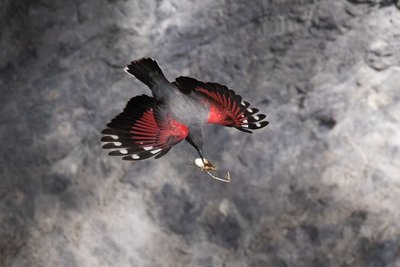
Tichodrome échelette - Pascal Saulay - Parc national des Écrins  Fauna
FaunaCliff-dwelling birds
The cliff is home to a variety of birdlife. The raven, not to be confused with the crow, frequently nests here. He makes an uncomfortable housemate with the peregrine falcon, a bird in sharp decline and still a vulnerable species. It, too, favours this cliff, which offers plenty of potential nesting holes. The wallcreeper, also known as the butterfly bird, also finds this a good nesting spot. Some climbing routes are closed during this bird's breeding season.
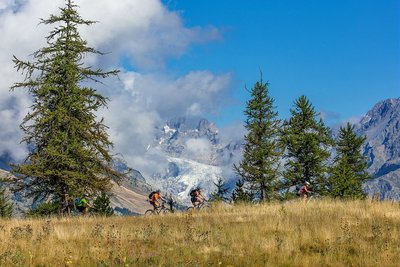
Col de la Pousterle - Bertrand Bodin - Parc national des Écrins  Pass
PassThe Col de la Pousterle
A pousterle (in the local high-alpine Occitan language) is a small gate, a postern. It comes from the Latin posterula which means back door. This place name is sometimes given to a pass, which could be described as a gateway between two valleys! The glaciers carved out this gateway through which an arm stretched between the glacier occupying the Fournel valley and the glacier flowing down the Vallouise valley.
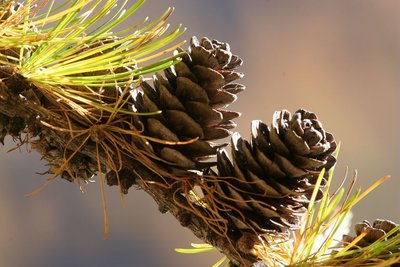
Mélèze avec cônes - Robert Chevalier - Parc national des Écrins  Flora
FloraThe larch
The symbol of the Southern Alps, this softwood tree loses its leaves in winter, and is swathed with gold and lights up the mountains in autumn. The larch forests are maintained by the grazing of flocks. Without them, other trees like the fir or other pine trees could grow, creating a different kind of forest. A pioneer species, the larch establishes freely in light conditions. Its solid rot-proof wood has always been used in the construction of houses.
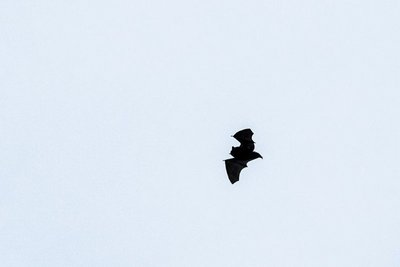
Chauve-souris en vol en contre jour - Mireille Coulon - Parc national des Écrins FaunaForest-dwelling bats
Bats don't just live in caves! In summer, some forest-dwelling species shelter in old hollow trees or woodpecker holes during the day. Sometimes, the females also form little colonies here, where their young will be born (one bat pup per female). In this forest, which is still young with very few old trees, artificial roosts have been installed to help the bats and to facilitate their study.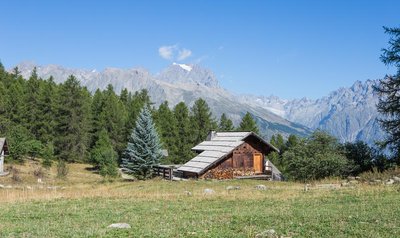
Chalet - Jan Novak  Panorama
Tournoux
The Tournoux plateau is a small paradise with its cool meadows, its occasional renovated chalets made from stone and larch wood and its view over the Tête d'Aval, an imposing limestone peak forming part of the Montbrison massif. Whether on a mountain bike, on foot or on cross-country skis in the winter, this spot is always an invitation to stop for a break!
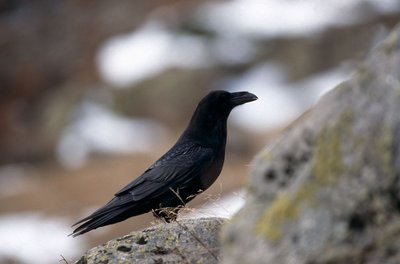
Le grand corbeau - Chevalier Robert - Parc national des Écrins FaunaThe common raven
A hollow "caw" makes you lift up your head (careful not to trip!). A pair of common ravens is nesting near here (they pair for life), on a cliff face. Although bigger than its cousins the carrion crow and the rook, it can be identified by its rather lozenge-shaped tail. It almost became extinct due to persecution Yet it's an omnivore and, more particularly, a scavenger which plays an important role by cleaning up disease-prone carcasses.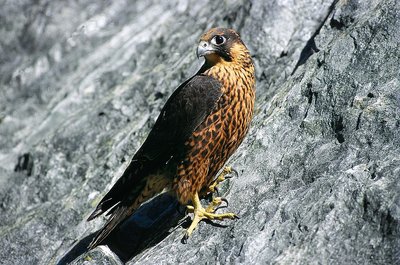
Faucon pèlerin - Fiat Denis - Parc national des Écrins FaunaThe peregrine falcon
Cries echo around the cliffs. A pair of peregrine falcons nests there regularly. A real "fighter plane" with tapered wings, it is a formidable predator of pigeons and other birds. It came very close to extinction because of pesticides, but it remains endangered because the eggs are still stolen for the falconry trade, even though it is a protected species. It is also sensitive to disturbance. Climbers are urged not to climb in this area in the spring.
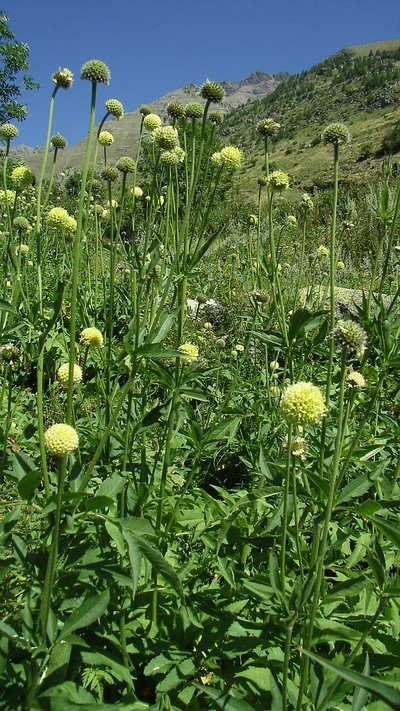
Céphalaire des Alpes - Marie-Geneviève Nicolas - Parc national des Écrins FloraThe yellow cephalaria
Rather like a tall scabious (up to 2 metres) but with pale yellow flower heads, this is not a common plant. Yet, at an intersection of two tracks, it has established on a small patch of ground. Who knows why! It is a mountain plant which only lives in the west of the Alpine Arc..
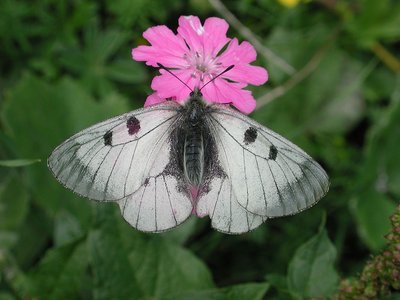
Semi-apollon - Gourreau Jean-Marie - Parc national des Écrins FaunaThe clouded Apollo
White, almost translucent in places, with just a few black spots, this butterfly is a cousin of the better-known mountain Apollo. It lives in clearings in open woods where the plant on which the female lays her eggs grows, and on which its caterpillars feed: the corydalis. It is a mountain butterfly.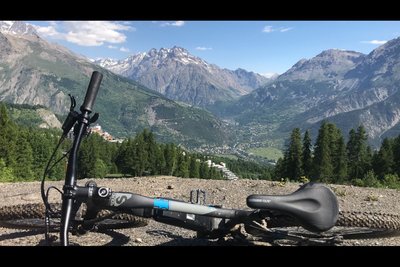
Lecture de paysage - Office de tourisme du Pays des Écrins PanoramaReading the landscape
The Vallouise valley is a tributary valley on the right-hand bank of the Durance. It is made up of three municipalities: Vallouise-Pelvoux, Les Vigneaux and, looking down from the heights, Puy-Saint-Vincent. This 25 km-long valley is dominated by numerous peaks, ranging in altitude from 980 metres, at the confluence of the Durance, to the peak of the Barre des Écrins at 4,102 metres (the highest point in the Les Écrins massif) and covers 18,541 hectares. Lying at the centre of the crystalline massif, the Vallouise valley is the gateway to the Parc National des Écrins and boasts exceptional and varied landscapes and a diverse wealth of fauna and flora.