

L’Argentière-la-Bessée : L’Horloge
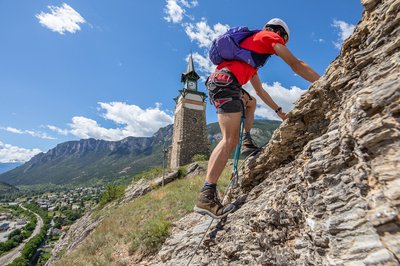
This via ferrata offers one of the finest viewpoints for taking in the history of the industrial town of L’Argentière-la-Bessée. It features a short, relatively easy climb suitable for everyone—even children!
Description
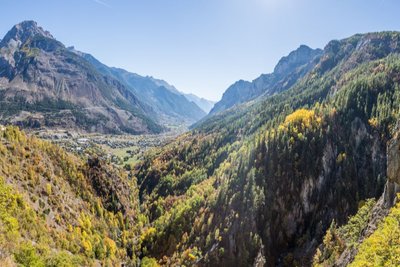
An ideal introductory route above the Durance Valley, this via ferrata leads to the Clock Tower without too much difficulty. Suitable for ages 10 and up and quick to complete, it offers superb views over the whole town of L’Argentière and the foothills of the Queyras, extending as far as Guillestre.
Access: From L’Argentière-la-Bessée, head toward the town centre. At the bandstand, turn right onto Rue des Collets, cross the railway line, and continue uphill to the Collets cliff car park on the left. From there, the approach is short and downhill.
Return: 15 minutes. Follow the path on the right back to the car park, descending via a 20-metre cable section across the cliff.
- Towns crossed : L'Argentière-la-Bessée
Les 1 parcours à découvrir
Recommandations
Be careful on the cable section during the descent. When accompanied by children, it is best for an adult to descend first, as some steps are easier when guided.
This via ferrata is very sunny, so it is best avoided during the hottest hours of the afternoon.
Emergency number: 112
Transport:
Public transportation: ZOU! https://services-zou.maregionsud.fr/fr/
Consider carpooling: BlaBlaCar http://www.blablacar.fr
Information desks
23 Avenue de la République, 05120 L'Argentière-La Bessée
Place de l'Eglise, 05340 Vallouise
12 points of interest
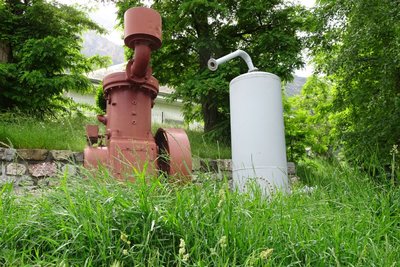
Le compresseur vertical - Office de tourisme Pays des Écrins  History
The vertical compressor
In 1910, a 22-year-old engineer, Gilbert Planche arrived in L'Argentière-La Bessée to take advantage of the water here and open a large aluminium factory.
The vertical compressor is the forerunner of the pneumatic drill. The mine operators needed a large quantity of coal and compressed air helped to accelerate coal output. In 1852, Swiss physicist Jean-Daniel Colladon invented the pneumatic drill. The vertical compressor enabled the production of compressed air which powered a drill and simplified coal excavation. The compressor is placed vertically on its support, hence its name.
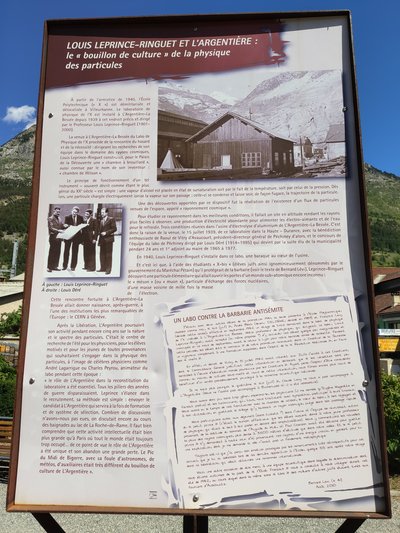
Louis Leprince-Ringuet et L'Argentière - Office de tourisme du Pays des Écrins HistoryLouis Leprince-Ringuet and L'Argentière
Louis Leprince-Ringuet was the director of the Physics Laboratory of X ("X" being a polytechnic school in Villeurbanne) established in L'Argentière. During the summer of 1942, he took in several Jewish students, thus saving them from the Nazis and deportation to Auschwitz. A panel presents the discoveries made by Louis Leprince-Ringuet in this laboratory. A text by Bernard Lévi is also displayed. As a young Jewish student, he took part in research at the laboratory during the summer of 1942. In it he thanks the scientific team for helping him to escape the anti-Semitic barbarism.
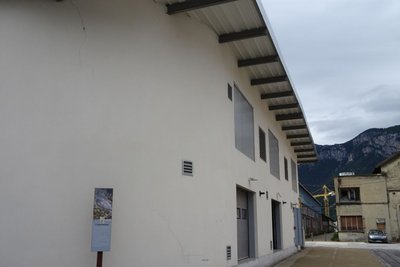
Anciennement l'usine Péchiney - Office de tourisme Pays des Écrins HistoryThe Péchiney factory
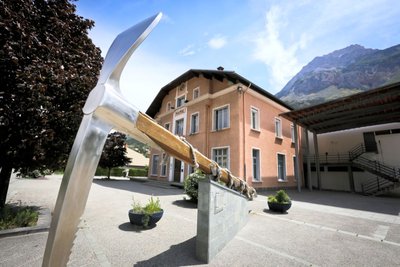
This French electro metal company established itself in L'Argentière in 1907. The construction of the aluminium factory started in 1909 and it opened its doors in 1910, powered by the electricity plant built by Gilbert Planche. With it, L'Argentière became an industrial town. The economic crisis of the 1970s and the rise of foreign sources of supply led to the factory's closure in 1985. It was partially demolished in 1988. The workers left the town and in order to prevent the abandonment of L'Argentière, a restructuring project was launched.
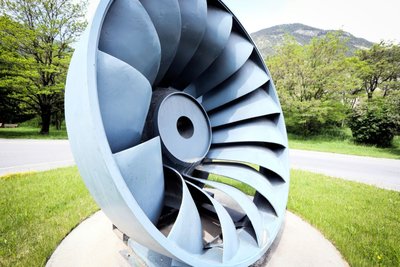
La turbine Francis - Jan Novak Photography HistoryThe Francis turbine
The American James Francis developed the Francis turbine between 1849 and 1855. It is a “àreaction” turbine suitable for medium-sized waterfalls (with a water head of between 15 and 500 metres). The water enters the turbine and then circulates between the turbine blades, which are fixed, while the inner wheel is mobile. The pressure at the wheel intake is greater than the pressure at the outlet.
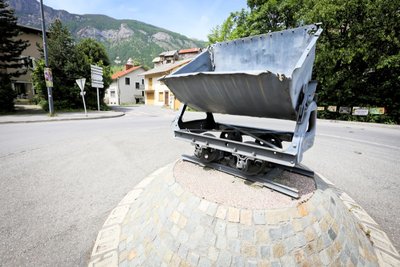
Un wagonnet - Jan Novak Photography HistoryThe Mines de Fournel rail-cars
Filled with materials excavated from the mine face, the rail-cars were pushed along the rails by the miners.
They were called “mine dogs”. They were originally made from wood and over time iron pieces were added. They were made entirely from metal by the end of the nineteenth century.
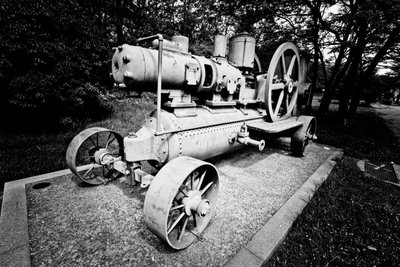
Le compresseur mobile - Jan Novak Photography HistoryThe mobile compressor
In the mines, compressed air is used to remove dust and to create power for the drills. The mobile compressor holds compressed air in a resistant tank. This is brought to a high pressure via a pump (the compressor). The compressed air is then distributed to the mine machinery through a conduit system.
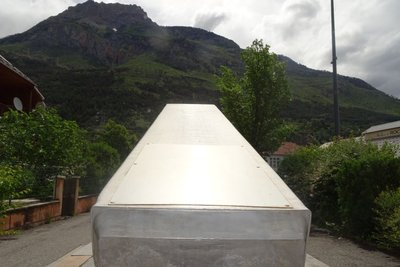
La barre d'aluminium - Office de tourisme Pays des Écrins HistoryThe giant aluminium bar
A young metal, aluminium is the most abundant metallic element on earth. Today, the aluminium industry is the second biggest after steel.
This enormous ingot was made in L'Argentière-La Bessée.
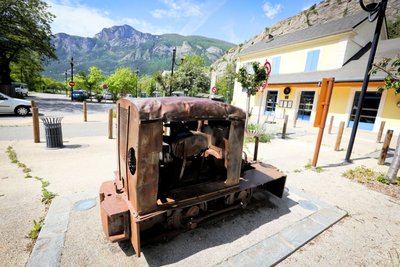
Le locotracteur - Jan Novak Photography HistoryThe light rail tractor
A locomotive? No, its little cousin, the light rail tractor. This replaced manually pushed carts and horse-drawn vehicles. Less powerful than a locomotive, it travelled along narrow-gauge tracks which could be laid on different types of terrain. An information panel also described the role of this vehicle during the Great War.
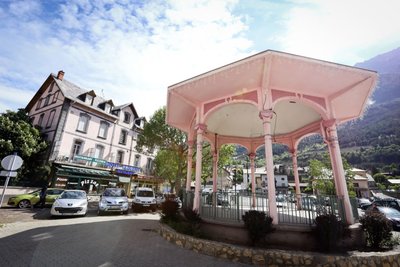
Kiosque à L'Argentière-La Bessées - Jan Novak Photography HistoryThe old workers' housing districts
Workers' housing districts were built to house the many workers who were employed at the Péchiney factory. These districts have now been demolished. The architecture of the houses varied according to the status of the employee. A town hall, a cinema, a bandstand and churches were also constructed.
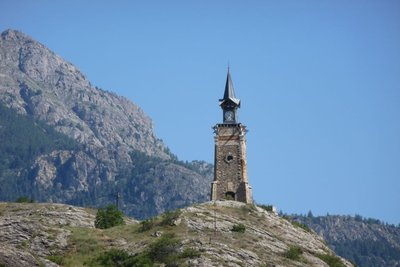
L'horloge des Hermes - Office de tourisme Pays des Écrins HistoryThe clock of Hermes
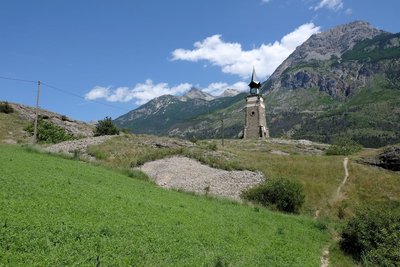
The Tour des Hermes is a clock tower built in 1922 by the Gilbert Planche company which used to run the aluminium factory in L'Argentière. It would chime to remind the factory workers of the time, and to make sure they arrived for work on time!
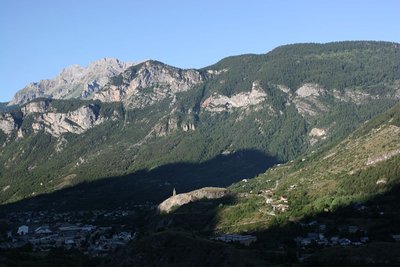
L'horloge des Hermes et L'Argentière-La Bessée - Thierry Maillet - Parc national des Écrins  Panorama
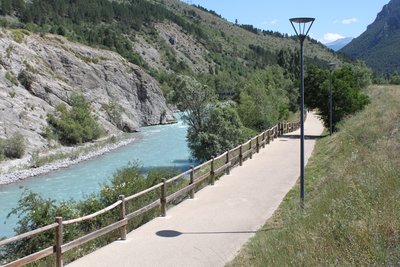
The view over the Durance valley
Protected from Atlantic influences by the Pelvoux massif, the upper Durance valley is subject to a very dry climate, with wide seasonal temperature fluctuations. It features grasslands very similar to the steppes of Central Europe, and which are rare in France. It is part of the Natura 2000 site, “Steppique durancien et queyrassien”.
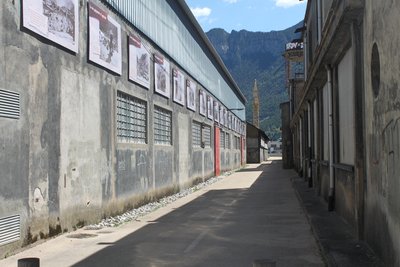
Anciennes industries de L'Argentière-la-Bessée - Office de tourisme du Pays des Écrins HistoryFormer industrial area of L’Argentière-la-Bessée
On the two walls of these now-disused industrial structures, you can read the history of L’Argentière-la-Bessée. The town is marked by its industrial past, in particular by the presence of a hydroelectric power station built between 1907 and 1909 to harness the power of the mountain waterfalls. At the time, it was the most powerful power station in Europe. Other industries were also established here, like the Société du Quartz Fondu fused quartz works and the aluminium factory which provided livelihoods for a large number of workers.
Access




Source

More information


