
Puy-Saint-Vincent : Tournoux
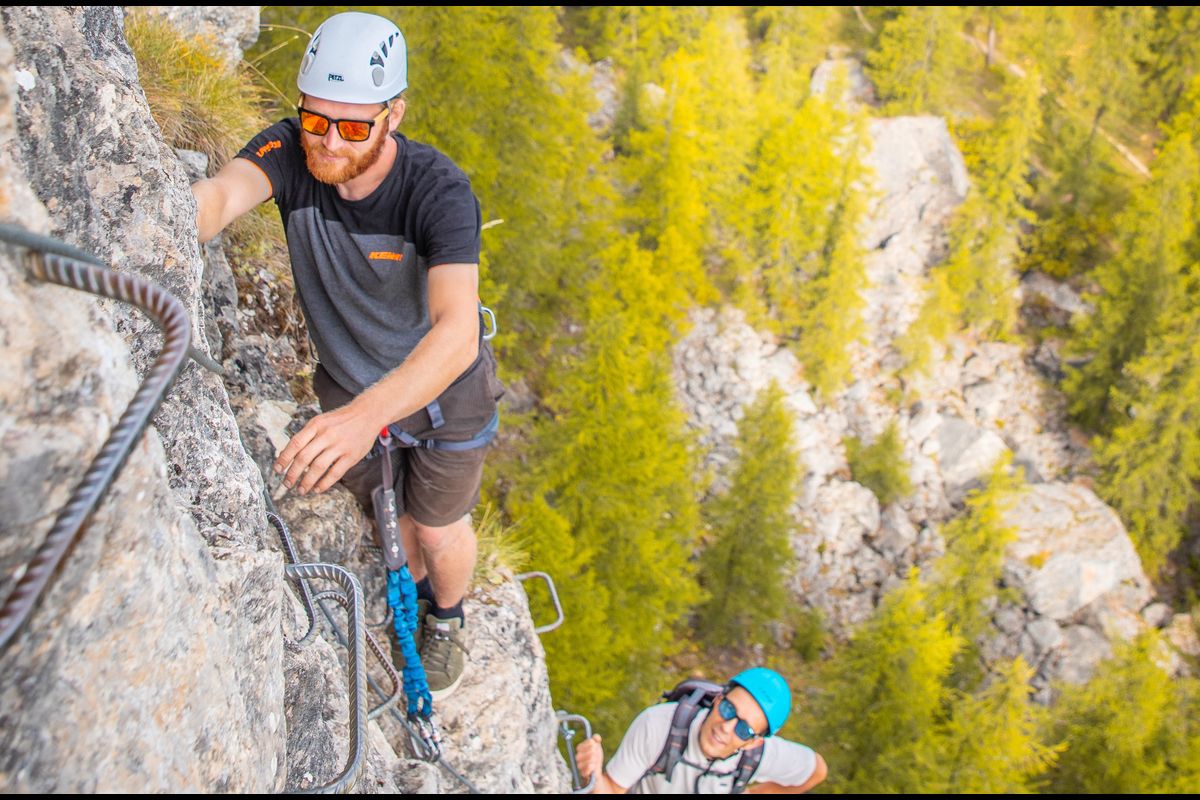
What could be better than a beautiful shaded cliff offering breathtaking views over the entire Écrins massif and the Vallouise Valley? This relatively secluded via ferrata, tucked away in the cliffside, features a few athletic sections without being excessively difficult.
Description
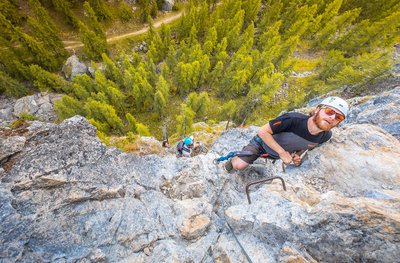
This beautiful limestone cliff is located between the summit of Les Têtes and Puy-Saint-Vincent, offering a stunning panorama over the northern Écrins. Thanks to the numerous rungs, the route is not very technical, although it does feature a few athletic and physically demanding sections, which are never very long. A few overhanging sections require some impressive moves.
The site is suitable for children aged 14 and over (approximately 1.50 m tall), provided they have some previous via ferrata experience.
Access: From Puy-Saint-Vincent 1400, follow the road towards Col de la Pousterle, which quickly becomes a drivable track. Park just before the large flat area before the pass, then take the trail on the right towards Tournoux. The start of the via ferrata is signposted along the trail.
Return: 10 minutes. From the foot of the cliff, simply join the main trail below and follow it back up to Col de la Pousterle.
- Towns crossed : L'Argentière-la-Bessée, Les Vigneaux, and Puy-Saint-Vincent
Les 1 parcours à découvrir
Sensitive areas
Peregrine falcon
- Impacted practices:
- Aerial, Vertical
- Sensitivity periods:
- FebMarAprMayJun
- Contact:
- Parc National des Écrins
Julien Charron
julien.charron@ecrins-parcnational.fr
Recommandations
Warning: Be careful when using handholds, as some rocks are loose and crumbly. Only rely on a hold once you are sure it is secure.
Hiking access:
During the approach hike, follow the cairns carefully.
For the return journey, it is preferable to take the route to the left and return via Col de la Pousterle to avoid the roped descent.
Emergency number : 112
Transports :
Public transports >> https://services-zou.maregionsud.fr/fr/
Carpooling >> www.blablacar.fr
Information desks

23 Avenue de la République, 05120 L'Argentière-La Bessée
Place de l'Eglise, 05340 Vallouise
72 impasse de la bergerie - Station 1600, 05290 Puy-Saint-Vincent
4 points of interest
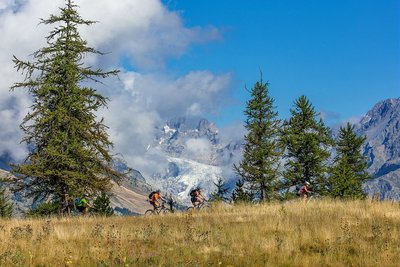
Col de la Pousterle - Bertrand Bodin - Parc national des Écrins  Pass
PassThe Col de la Pousterle
A pousterle (in the local high-alpine Occitan language) is a small gate, a postern. It comes from the Latin posterula which means back door. This place name is sometimes given to a pass, which could be described as a gateway between two valleys! The glaciers carved out this gateway through which an arm stretched between the glacier occupying the Fournel valley and the glacier flowing down the Vallouise valley.
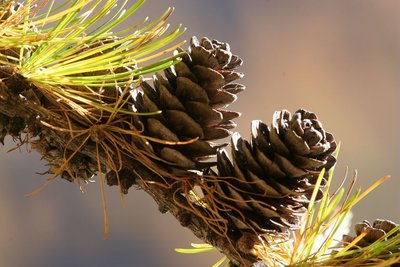
Mélèze avec cônes - Robert Chevalier - Parc national des Écrins  Flora
FloraThe larch
The symbol of the Southern Alps, this softwood tree loses its leaves in winter, and is swathed with gold and lights up the mountains in autumn. The larch forests are maintained by the grazing of flocks. Without them, other trees like the fir or other pine trees could grow, creating a different kind of forest. A pioneer species, the larch establishes freely in light conditions. Its solid rot-proof wood has always been used in the construction of houses.
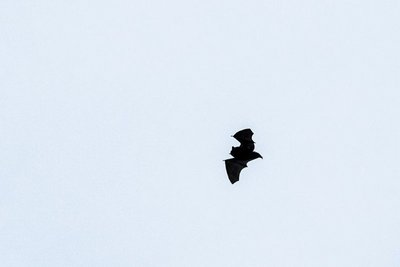
Chauve-souris en vol en contre jour - Mireille Coulon - Parc national des Écrins  Fauna
FaunaForest-dwelling bats
Bats don't just live in caves! In summer, some forest-dwelling species shelter in old hollow trees or woodpecker holes during the day. Sometimes, the females also form little colonies here, where their young will be born (one bat pup per female). In this forest, which is still young with very few old trees, artificial roosts have been installed to help the bats and to facilitate their study.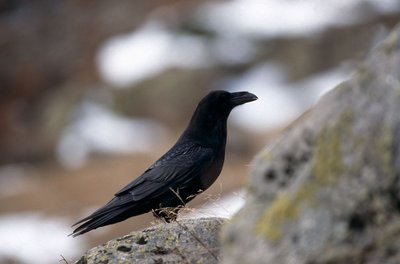
Le grand corbeau - Chevalier Robert - Parc national des Écrins FaunaThe common raven
A hollow "caw" makes you lift up your head (careful not to trip!). A pair of common ravens is nesting near here (they pair for life), on a cliff face. Although bigger than its cousins the carrion crow and the rook, it can be identified by its rather lozenge-shaped tail. It almost became extinct due to persecution Yet it's an omnivore and, more particularly, a scavenger which plays an important role by cleaning up disease-prone carcasses.
Access








Source

More information


